
ePCR Software Cost: Per-Tag vs Per-Seat Pricing
Compare ePCR software cost models for fire and EMS agencies, and see how per-tag pricing with no seat or device fees ties spending to real call volume.

If you look at ePCR software cost per tag instead of per seat, the math changes fast. With per-tag pricing, your agency pays for each patient care report a crew uploads, not for every name on the roster or every iPad on the apparatus floor. Mobile Medic works this way: no seat fees, no device fees, and a bill that follows your run volume.
Here's why that matters. Say your department runs about 150 calls a month but carries 45 people on the roster once you count part-timers and volunteers. Under a seat license, you're paying for a lot of logins that sit idle most of the month. Under per-tag billing, the software line in your budget moves with the work your crews actually do.
Below we'll walk through how per-tag pricing works, why seat licenses are hard on combination departments, and what to ask for so the budget holds up in front of your city manager.
Why do seat licenses hurt combination departments?
A lot of EMS software pricing grew up around private ambulance fleets with a fixed number of full-time medics. That works fine when your roster and your charting load line up. It doesn't work so well for a combination fire department or a volunteer squad.
Think about a department that staffs one engine and one rescue. To cover shift trades, sick calls and busy weekends, the roster can run far larger than the number of people charting on any given day. Under a per-seat contract, the volunteer who writes two charts a month costs the same as the medic who writes forty.
Per-device pricing creates its own headache. If every tablet carries a yearly fee, nobody wants spare iPads sitting in the captain's office. Then a screen cracks on the freeway, and that crew is charting on paper until a replacement gets approved.
Seat licenses can also push people into bad habits. To keep costs down, some crews start sharing logins across shifts. That wrecks personal accountability, muddies your QA review and makes it hard to say who wrote what on a chart that ends up in a deposition.
How does ePCR software cost per tag follow volume?
A "tag" is a completed patient care report. With per-tag pricing, the agency pays when a crew uploads a real chart, not for people who might chart someday.
That keeps your charting budget tied to call volume. If an icy winter brings more wrecks, tag volume goes up, and if your agency bills for transport, so does the revenue from those runs. If spring is quiet, the software bill drops with it.
Finance directors tend to like that. Instead of locking tax dollars into seats that may sit empty, the software line behaves like an operating expense that tracks service demand. It also fits the kind of planning the Government Finance Officers Association recommends, where recurring revenue should cover recurring costs.
Roster growth stops being a budget event, too. When you bring on a recruit class or seasonal medics, you set up their accounts and put them to work. You don't need to go back to council for a contract amendment just to add logins.
If you're still comparing vendors, our guide on how to choose ePCR software without hidden costs covers the questions to ask before you sign anything.
What does "no seat or device fees" mean day to day?
Mobile Medic charges $0 per user seat and $0 per device. In practice, that's an unlimited iPad ePCR license for your whole fleet.
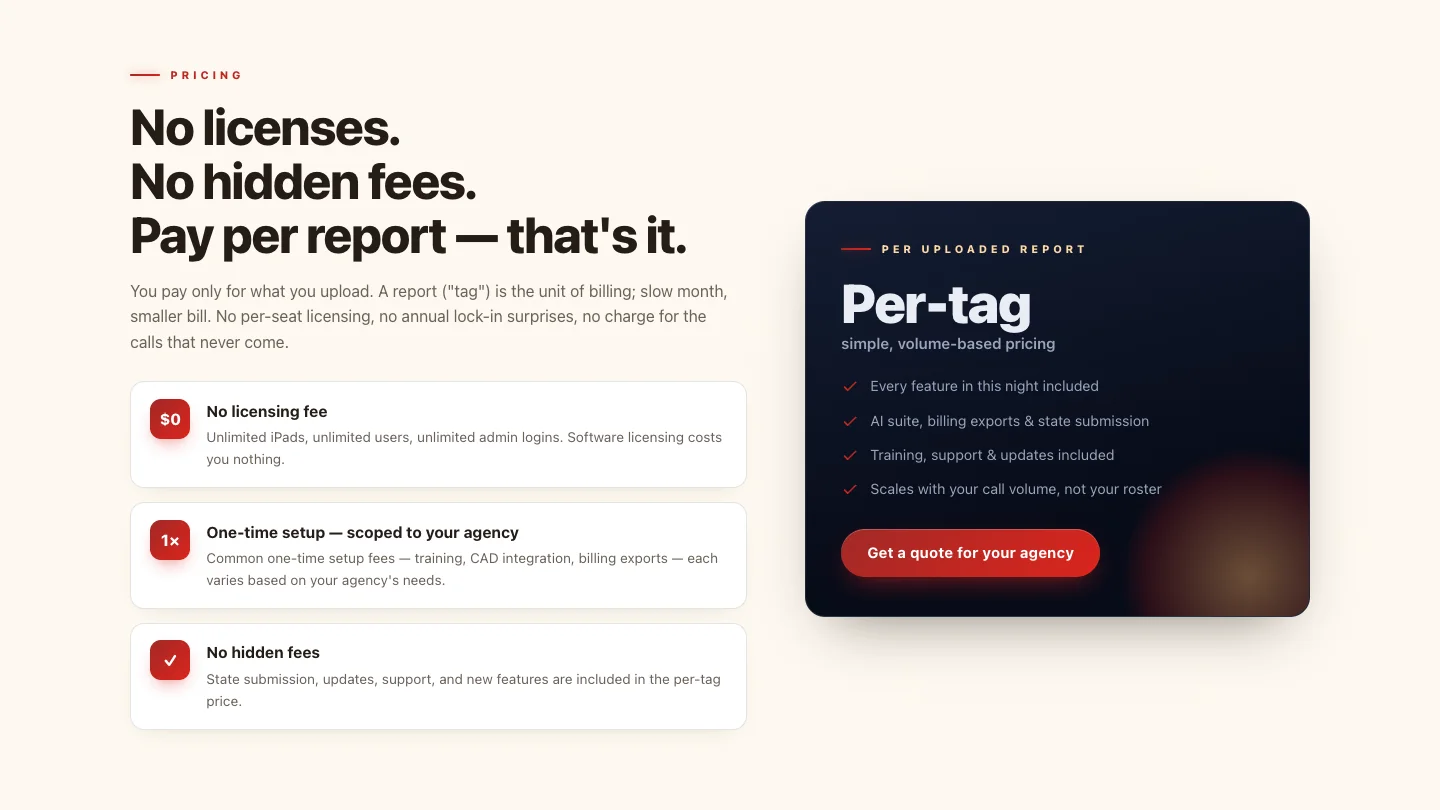
You can put the Medic Clipboard app on every frontline rig, the reserve engine and the chief's truck. You can keep a few spare iPads charged in the office without adding a line item. If a tablet gets soaked in the rain or run over on scene, the crew grabs a spare, logs in and keeps going.
Charts sync to the cloud whenever the iPad finds a signal, so anything that's already synced isn't stuck on the broken tablet. Our post on offline-first ePCR architecture explains how that sync works when you're charting in a basement with no bars.
The same goes for people. Admins can give individual logins to full-time medics, part-time EMTs, reserve volunteers, QA reviewers, medical directors and billing staff. Access is managed with role-based permissions, and everybody signs in as themselves, so you never have a reason to share a login to save money.
What does the one-time onboarding fee cover?
Nobody wants surprise bills after signing. Sometimes a proposal looks clean, and then the invoices for dispatch hookups, billing setup and training start showing up.
Mobile Medic uses a one-time onboarding fee sized to your agency. It covers three things:
- Dispatch CAD integration: Connecting your 911 dispatch feed to the field iPads, so unit details, incident numbers, run times, addresses and dispatch complaints come into the chart with one tap. Nothing overwrites the medic's clinical notes without their OK.
- Billing export setup: Configuring your NEMSIS exports and billing files so data goes where your staff or billing company needs it.
- Train-the-trainer coaching: Working with your department instructors, who then roll the app out to A, B and C shifts. Because the screens follow the paper PCR layout your crews already know, most agencies are field-ready after one session.
After onboarding, you're on the regular per-tag rate.
What's included in the per-tag rate?
Some software quotes work like a cable bill. The base price looks reasonable, and then the tools you use every shift turn out to be add-ons.
When you get any quote, it's worth asking directly whether these cost extra:
- State NEMSIS exports
- Camera scanning for licenses, face sheets and pill bottles
- Field protocol references
- Hospital-facing screens or offload time tracking
- Phone support that reaches a person
With Digital EMS Mobile Medic pricing, the AI tools (including the MedsAI bedside medication scanner, voice dictation and document capture), state NEMSIS submissions, billing exports, ongoing feature updates and customer support are included in the base per-tag price. Other modules, such as the controlled substance witness log, NERIS fire reporting and CAD reconciliation, are part of the same platform, and your quote will spell out what's included for your agency. When you call support, you reach technicians who know fire and EMS operations, not a general call center queue.
How do per-seat and per-tag budgets compare?
Here's how the two structures play out against everyday department realities.
| Budget factor | Per-seat model | Mobile Medic per-tag model |
|---|---|---|
| Roster access | Each named user carries a yearly fee, so roster growth raises the bill | No seat fees; unlimited crew, officer and QA logins |
| Device fleet | Each tablet may carry its own fee, including spares | No device fees; unlimited iPads on frontline and reserve apparatus |
| Call volume swings | The bill stays the same in a slow month | The bill follows uploaded charts, so slow months cost less |
| Feature access | Some tools may be priced as add-on modules | AI tools, NEMSIS submissions, billing exports, updates and support included |
| Forecasting | Seat creep and add-ons make the number harder to predict | Spend tracks your historical call volume |
How might this look for a combination department?
Take a hypothetical suburban combination district with two stations, one ALS engine and one ambulance. The roster has 12 full-time members, 24 part-time medics and 9 volunteers, so 45 people in all. The district runs roughly 1,800 medical calls a year, or about 150 a month.
Under a seat-and-device contract, that district pays for all 45 people and every tablet, whether those folks chart once a month or every shift. Spares and reserve rigs add cost, which is exactly why departments end up skipping them.
Under per-tag pricing, the district can outfit every rig, keep a couple of spare iPads in quarters, give every member their own login, and pay based on the charts it actually uploads. When call counts dip in a quiet month, the savings stay in the budget for station gear or training. Whether per-tag comes out cheaper for your agency depends on your run volume, your roster and the quotes in front of you, so run your own numbers.
Frequently asked questions
Is there a minimum monthly tag volume?
Digital EMS works with agencies of all sizes, from rural squads to busy fire departments. Because you pay per tag, a slow season means a smaller bill. Expected tag volume comes up during initial talks, based on your agency's run history, so that's the time to ask about any contract terms.
How much does it cost to add spare iPads?
Nothing in software fees. Mobile Medic charges $0 per device, so you can buy standard Apple iPads and install Medic Clipboard across your reserve fleet. You only pay when a crew uploads a real patient chart.
Are CAD integration and NEMSIS exports monthly add-ons?
No. CAD integration and billing export setup are handled during the one-time onboarding. State NEMSIS submissions and billing exports are included in the standard per-tag rate.
How does billing work during seasonal call surges?
Because per-tag billing tracks uploaded charts, your invoice follows call activity. When summer crowds or a storm push volume up, the bill goes up with the work, and for agencies that bill for transport, the extra runs bring in revenue too. In slow months, you aren't paying for capacity you didn't use.
How long does train-the-trainer rollout take?
Most departments are field-ready after one train-the-trainer session. Because Medic Clipboard mirrors the paper run form crews learned in school, people pick up the screens quickly. Your training officers then bring the workflow to each shift on a schedule that fits your department.
Want to see what per-tag pricing would look like for your call volume? Check the Mobile Medic pricing section and give us a call.