NEMSIS 3.5.1 Compliance: A Field Prep Guide for Crews
A field guide to NEMSIS 3.5.1 compliance: the new data elements crews will see, why state rules block charts, and how to test exports before your deadline.

NEMSIS 3.5.1 compliance means your patient care reports match the current national EMS data standard and pass your state's own validation rules before the state accepts them. Each state picks its own switchover date, so the deadline you care about is the one your state EMS office published, not a national one. On the street, you feel it when a chart that closed fine last month suddenly won't submit from the hospital driveway.
Nobody wants to sit in the cab at 06:45 clicking through red banners. Knowing what changed, and why the state's rules flag what they flag, keeps charts moving and gets you back in service.
What is NEMSIS 3.5.1 and why does it matter now?
NEMSIS is the national standard that defines what goes into an EMS patient record and how it's coded. Version 3.5.1 is the current release in the 3.5 family. NEMSIS published it in early 2025, and its change log lists the new elements and code updates it added on top of 3.5.0.
States move on their own schedule. Illinois, for example, began accepting 3.5.1 records in June 2026 and set September 1, 2026 as its deadline, after which it stops accepting version 3.4 data. Your state's timeline is on the NEMSIS state map, and your state EMS office will have the final word.
When a state upgrades, it also loads a new rule file. NEMSIS calls these Schematron files, but think of them as the state's checklist: a set of business rules every chart has to pass before the state takes it. If your software sends old-version data, or data that breaks one of those rules, the state rejects the run and your QA officer ends up chasing it.
Which new 3.5.1 elements will crews notice first?
Most of the 3.5.1 additions are state-level elements, which means your state decides whether to require them. Here's what shows up most often on a real shift.
| Element | What it captures | What crews should do |
|---|---|---|
| ePatient.25 Patient Sex | Male, female, unknown, or not recorded | Fill it in every time, since some states won't accept the chart without it |
| ePatient.24 Preferred Language(s) | The patient's preferred language, from a standard code list | Ask and record it when your state collects it |
| eMedications.13 Medication Administered by Another Unit | A yes or no flag for meds another unit gave while on scene with you | Flag the engine's dose so it isn't credited to your crew |
| eProcedures.15 Procedure Performed by Another Unit | The same flag for procedures | Use it when another crew does the procedure on a shared scene |
| eProcedures.14 Airway Placement Technique | How the advanced airway went in, such as direct or video laryngoscopy | Pick the technique you actually used |
| eVitals.34 Stroke Scale Score | The number that goes with the stroke scale type you picked | Enter the actual score instead of "positive" |
Patient sex replaced the old gender field
In 2025, NEMSIS released a critical patch for both 3.5.0 and 3.5.1 that deprecated the old gender element (ePatient.13) and added a new sex element (ePatient.25). California's EMS Authority described the mapping in a May 2025 memo. States handle the transition differently. Illinois, for one, still collects the old gender element but requires the new sex element to pass validation. Check your own state's guidance before you assume your current form is good.
Meds and procedures from another unit on scene
This one trips people up. eMedications.13 and eProcedures.15 aren't for care given before you arrived. They're for care another unit gives while you're both working the patient. If the engine medic pushes naloxone while you're setting up the monitor, flag it as given by another unit. Prior-to-arrival care still goes where it always has.
Airway technique and stroke scores
eProcedures.14 records how the tube went in. Confirmation, like waveform capnography, still gets documented in its own fields, and your state may add a rule that flags an advanced airway logged without it. For strokes, eVitals.34 pairs a numeric score with the scale your agency uses, whether that's Cincinnati, LAMS, or another tool. A checked box that just says "positive" won't feed a state stroke registry.
Why do state validation rules block a chart?
State rules block a chart because they layer your state's requirements on top of the national ones. NEMSIS sets the base rules, and your state EMS office adds its own. Your state might require a blood glucose on every altered mental status call. If it's blank, the chart doesn't pass.
The painful version is when your software lets you sign off and the state rejects it hours later. Better setups check the state's rules on the tablet while you're still charting, so you fix the problem while the call is fresh.
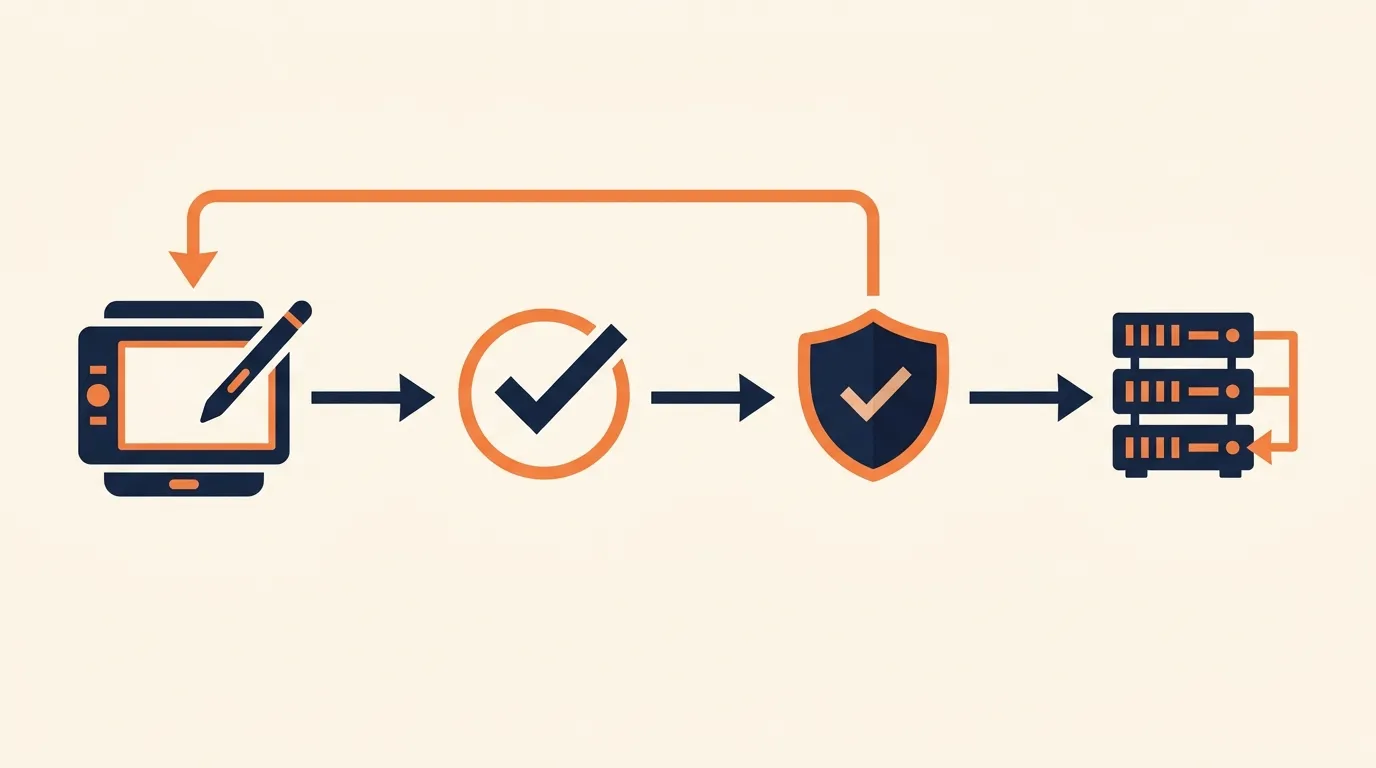
Common causes of NEMSIS validation errors in EMS charts include:
- A cardiac arrest with no time CPR started
- A canceled-en-route call with no disposition
- A refusal with no documented decision-making capacity check (our refusal documentation guide covers what a defensible refusal needs)
- A medication route that doesn't fit the medication
Catch these on scene or in the ED bay and your shift ends on time.
What does a validation error look like on shift?
How should agencies test for NEMSIS 3.5.1 compliance?
Test before you go live. Run sample charts through a test setup with your state's current rule file, fix what breaks, then switch on live submissions. That takes coordination between operations, billing, and your software vendor, and it starts with running NEMSIS compliant ePCR software. NEMSIS lists vendors and their testing status by version on its compliant software page.
Administrators can work through four steps:
- Get the newest state rule file. Your state EMS office publishes it, and states update these files as their reporting needs change.
- Send test charts. Run sample arrests, refusals, trauma calls, and interfacility transfers. Custom agency pick lists are a common place for old codes to hide.
- Look at the warnings from the crew's side. A good setup tells medics what's missing without burying them in pop-ups. Our post on fair chart audits covers how QA can follow up without piling on.
- Confirm the automatic send. Once a chart passes, it should go to the state on its own, and someone should be able to see that the state received it.

If you're replacing software as part of the move, our guide to choosing ePCR software walks through what to ask vendors. Fire departments facing a parallel reporting change can start with our NERIS transition guide.
What habits keep crew charts passing validation?
Five habits prevent most rejections:
- Sort out who gave what. Separate prior-to-arrival care from care another unit gave while you were on scene.
- Document airway confirmation right away. Log waveform capnography and lung sounds as soon as the tube's in.
- Enter the stroke score itself. Pick the scale and enter the number.
- Fill in patient sex. Your state may require it even if it still collects the older gender field.
- Run the check before you leave the hospital. Fixing a warning takes a minute while the call is fresh. It takes a lot longer the next day.
Mobile Medic is certified NEMSIS 3.5 compliant and sends pre-validated charts to state repositories on a schedule, with alerts when a submission fails. You can see how that works on our features page.
Frequently asked questions
What happens if our agency misses the state NEMSIS 3.5 transition deadline?
Your state stops accepting charts in the old version, so your uploads get rejected until your software sends the version the state expects. What follows depends on your state's rules for reporting, so ask your state EMS office what it means for your license or contracts.
What's the practical difference between NEMSIS 3.5.0 and 3.5.1?
Version 3.5.1 builds on 3.5.0. It adds a set of new elements, mostly state-level ones like stroke scale score, airway placement technique, and the "another unit" flags for meds and procedures, along with code list updates. The NEMSIS change log lists each one.
Why does my ePCR let me close a chart that the state later rejects?
Usually the rules on your tablet don't match the rule file the state is running now. If the software doesn't check against the state's current rules before it sends, a chart can look fine locally and still fail at the state. Updating the agency's rule file closes the gap.
How can administrators check whether their ePCR is NEMSIS 3.5.1 compliant?
Start with the compliant software testing status page on nemsis.org, which lists vendors by version and testing stage. Ask your vendor which version they're certified for and when they last tested.
Do field medics need to learn data codes to chart?
No. Medics never see the raw codes. A good ePCR turns NEMSIS elements into plain buttons and pick lists, so you chart the care and the software handles the formatting the state needs.
Sources
- NEMSIS: National EMS Information System (external site)
- NEMSIS v3.5.1 Change Log (PDF) (external site)
- NEMSIS v3.5 Resources (external site)
- NEMSIS State Map (Version 3 state timelines) (external site)
- NEMSIS Version 3 Schematron (external site)
- NEMSIS Compliant Software Testing Status (external site)
- California EMS Authority memo: CEMSIS Critical Patch (May 2025, PDF) (external site)
- Illinois Department of Public Health memo: NEMSIS Version 3.5.1 (June 2026, PDF) (external site)