Prehospital Cardiac Arrest Quality Review: A QA Guide
A prehospital cardiac arrest quality review guide: compression fraction, monitor case files, clock drift, CARES reporting and debriefs that coach crews.

A prehospital cardiac arrest quality review answers one question: did the CPR your crew delivered match the CPR they remember? The answer lives in the monitor file, not the narrative. Compression fraction, rate, depth and the pauses around shocks are the numbers that matter, and most of them never make it into the run report on their own.
Every medic has walked out of a code thinking the compressions were solid. Then the impedance tracing shows a gap nobody felt. That isn't a character flaw. It's what happens when you're managing an airway in a cramped bedroom with three people talking at once. Good review turns that data into coaching instead of blame.
Which resuscitation metrics matter most in QA?
Start with chest compression fraction (CCF), the share of the code where someone's hands are actually on the chest pushing. The American Heart Association's 2013 CPR quality consensus statement set the target above 80%. Every pause for a pulse check, a rhythm analysis or a tube eats into that number.
Next come rate and depth. Current AHA guidelines call for 100 to 120 compressions a minute and, in adults, at least 2 inches but no more than 2.4 inches of depth. Full recoil between compressions matters too, because leaning on the chest keeps the heart from refilling.
Then look hard at the pauses around shocks. A study from the Resuscitation Outcomes Consortium found that patients whose pre-shock pause stayed under 10 seconds had better odds of survival than those whose pause ran past 20 seconds. Pre-charging the monitor during compressions is one of the easiest fixes.
Waveform capnography rounds it out. AHA guidance treats an ETCO2 that stays under 10 mmHg during CPR as a sign the compressions need work, often a tired compressor who should swap out. A sudden jump in ETCO2 can be the first hint of ROSC, sometimes before anyone finds a pulse.
How do monitor case files feed the review?
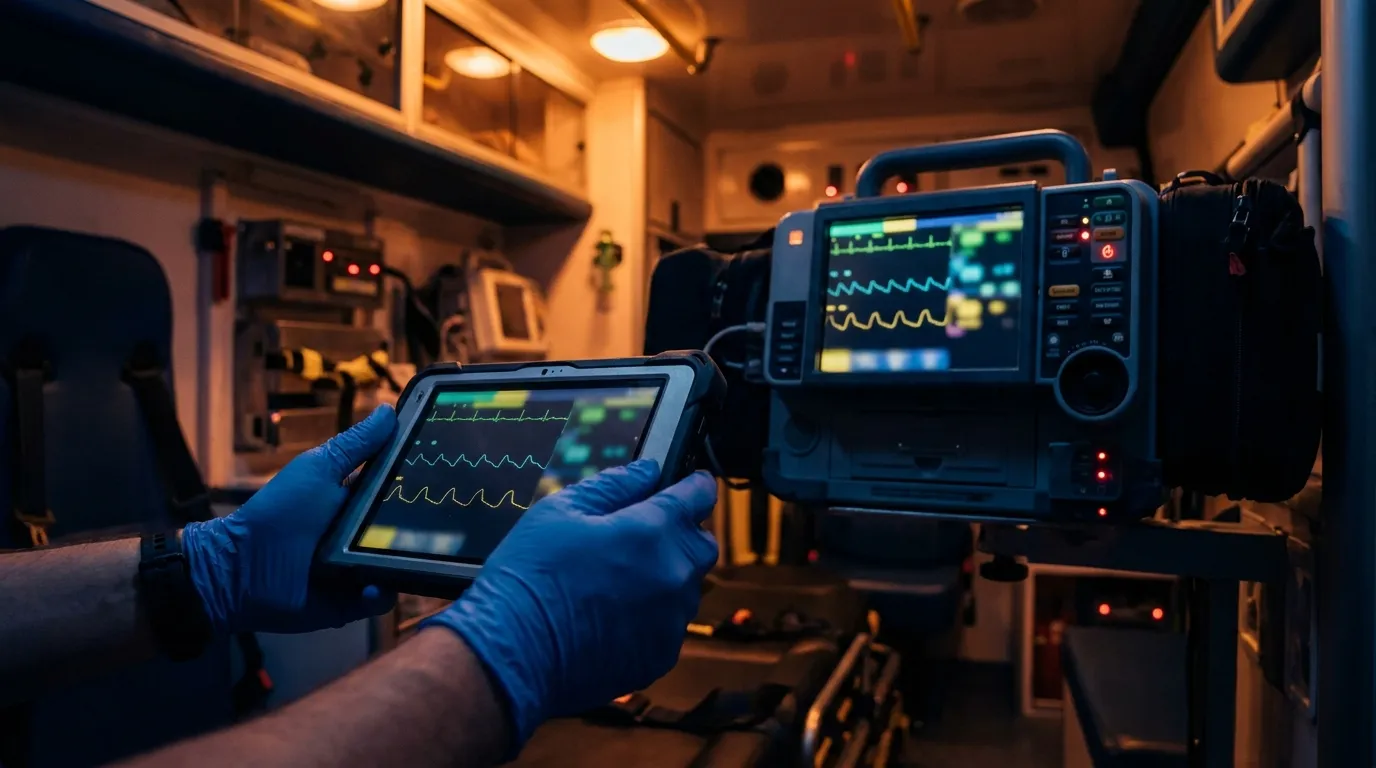
A defibrillator case file review means getting the monitor's full code record next to the chart. The monitor logs far more than the printed strip. Chest impedance changes with every compression, so the tracing shows when compressions started, stopped and how fast they ran.
That's where hidden pauses show up. When someone stops to place an airway, the impedance line goes flat, and it stays flat for exactly as long as hands were off the chest. No one on scene counts those seconds accurately. The tracing does.
The file also holds shock times, energy settings and rhythm strips. Lined up with the run report, it lets a reviewer see when epinephrine went in relative to the last pause or shock. If your monitor data still comes over by hand or not at all, our guide on cardiac monitor to ePCR transfer fixes walks through the common breakdowns.
How does clock drift distort an arrest audit?
Dispatch CAD clocks usually sync to network time. Monitor clocks often don't, and they drift unless someone resets them. Even a minute of drift makes a clean code look sloppy on paper.
Say CAD logs your arrival at 03:14:00 but the monitor clock runs ahead, so its first compression appears to come long after you walked in. The audit flags a delay that never happened. Drug intervals get skewed the same way.
The fix is boring but it works: sync monitor clocks to network time whenever they pair with a tablet or dock in quarters, and note any known offset in the chart. We cover the details in CAD timestamp and monitor clock mismatch fixes.
How do you report clean data to CARES?
The Cardiac Arrest Registry to Enhance Survival (CARES) is how many agencies compare their arrest outcomes with peers. It's built on the Utstein reporting style, which captures the factors that drive survival.
Those factors include whether the collapse was witnessed, whether a bystander started CPR and whether the first rhythm was shockable. The Utstein comparison group, witnessed arrests with a shockable first rhythm, is the one most systems watch, because it says the most about how well your chain of survival works.
Typing the same call into the chart and then again into the registry wastes a coordinator's morning and invites typos. Ask how your ePCR maps its arrest fields to CARES, and whether that hand-off can happen without retyping. Hospital outcome data closes the loop, which we dig into in hospital and EMS data exchange.
How should QA officers debrief crews after an arrest?
Arrest data is for teaching, not punishing. Call a crew in to pick apart their mistakes and they'll stop talking. Start from the tracing, not from anyone's opinion of how the call went.
Put the waveform up on a screen. If the crew held 88% compression fraction through most of the code, say so first. Then look at the 14-second gap around the second shock together and ask what was going on in the room.
Framed that way, a long pause becomes a choreography problem the whole team solves, which is the core idea behind the Resuscitation Academy's pit-crew approach. Maybe the defib pads and the IV line keep tangling, or the airway person and the compressor are fighting for the same spot. Crews coached this way often start asking for their own reviews. For building a fair audit program around this, see EMS QA/QI software for fair chart audits.
What should post-ROSC documentation show?
Getting a pulse back is the start of the next phase, not the finish. Reviewers check whether the crew protected the brain once the heart was beating again.
Blood pressure comes first. The 2020 AHA adult guidelines recommend avoiding a systolic pressure under 90 mmHg and a mean arterial pressure under 65 mmHg after ROSC. When pressures sag, the chart should show the fluid bolus or pressor and when it started.
Ventilation is the next trap. Bagging fast and hard after ROSC is common and it hurts. The AHA guidance aims for normal CO2 levels, roughly a PaCO2 of 35 to 45 mmHg, so reviewers look for a steady, moderate rate and a capnography reading in a normal range.
Finally, the chart should include a post-ROSC 12-lead to catch a STEMI and give the cath lab a head start, plus any temperature management your protocols call for.
What can impedance review catch that crews miss?
Here's a composite example of the kind of case these reviews surface. A medic unit and an engine work a witnessed arrest in a tight bedroom, refractory V-fib. At the debrief, the paramedic remembers steady CPR through the whole call. The narrative says compressions only paused briefly for the shocks.
The impedance tracing tells a different story: an 18-second gap about eight minutes in, during a difficult intubation attempt. Nobody in the room realized how long it took.
Nobody got written up. The medical director used the tracing to change the pit-crew plan so a supraglottic airway goes in first during active CPR, with intubation held until there's a clear reason for it. That's the payoff of a good review: one tracing changes the protocol for every crew in the system.
What's in a prehospital cardiac arrest quality review?
A consistent checklist keeps reviews fair from one crew to the next. These are the targets most reviewers start from:
| Review metric | Target | Where to check | Why it matters |
|---|---|---|---|
| Chest compression fraction | Above 80% | Impedance tracing | Shows how continuous CPR really was |
| Compression rate | 100 to 120 per minute | Monitor CPR data | Too fast cuts refill time |
| Compression depth | 2 to 2.4 inches in adults | CPR feedback sensor | Drives forward blood flow |
| Pre-shock pause | As short as possible, well under 10 seconds | Charge and shock times | Longer pauses linked to worse survival |
| ETCO2 during CPR | Not stuck under 10 mmHg | Capnography waveform | Low values flag weak compressions |
| Post-ROSC blood pressure | SBP 90 or higher, MAP 65 or higher | Vital sign trend | Protects brain perfusion |
Frequently asked questions
How should crews document mechanical CPR transitions?
Log the time manual CPR stopped and the time the device started compressing, and keep that switch pause as short as you can. Charting both phases lets reviewers figure manual and mechanical compression fraction separately.
How accurate are CPR feedback sensors in the field?
On a hard floor, they're quite good. On a soft mattress, the sensor counts the mattress flexing along with the chest, so depth reads deeper than it really is. Get the patient on a backboard or the floor if you want honest depth numbers.
How is pediatric arrest review different from adult QA?
Airway, oxygenation and weight-based dosing get more attention, since pediatric arrests are more often respiratory in origin. Compression depth is at least one third of the chest's depth, about 1.5 inches in infants and about 2 inches in children, per the 2020 AHA pediatric guidelines.
What do reviewers check on a field termination of resuscitation?
They check the call against your local termination protocol: how long resuscitation ran, the rhythm, the ETCO2 trend and any criteria specific to trauma arrests. They also confirm the chart shows the online medical control contact when your protocol requires it.
When are CARES submissions due?
Agencies generally enter arrest records throughout the year, and CARES closes each year's dataset on a schedule it sets with participating agencies. Check with your state or local CARES coordinator for the exact date, and don't wait until the end of the year, since hospitals need time to add outcome data.
How can software take the busywork out of arrest QA?
Reviewing arrests from paper charts and thumb drives eats hours, and coordinators fall behind on both reviews and registry entries. The less retyping and file hunting your team does, the more time goes into coaching.
Mobile Medic pulls 12-lead ECGs, interpretations and vital sign trends from ZOLL and LIFEPAK monitors straight into the chart, and configurable QA monitors in the office web app can flag cases like pediatric arrests for targeted review. CPR quality data isn't broken out into chart fields, but the full ZOLL case file or LIFEPAK case summary is attached to the record so reviewers can dig into it. See how it fits your review process on our features page.
Sources
- AHA: CPR Quality, Improving Cardiac Resuscitation Outcomes Both Inside and Outside the Hospital (2013) (external site)
- AHA 2020 Guidelines, Part 3: Adult Basic and Advanced Life Support (external site)
- AHA 2020 Guidelines, Part 4: Pediatric Basic and Advanced Life Support (external site)
- Cheskes et al., Perishock Pause (Circulation, 2011) (external site)
- Cardiac Arrest Registry to Enhance Survival (CARES) (external site)
- Resuscitation Academy (external site)